Written by:Tomasz Sadowski
This article is for educational purposes and reflects information from FDA drug labelling, peer-reviewed toxicology and pharmacology references, and evidence-based sports-nutrition guidelines. It is not a substitute for individualised medical advice. Sodium bicarbonate, even as a common kitchen ingredient, has a narrow therapeutic window and real toxicity risks. If you have questions about using baking soda for health purposes — particularly if you have heart, kidney, or blood-pressure conditions — consult your GP or pharmacist before starting.
tl:dr
Baking soda (sodium bicarbonate) dissolved in water has legitimate short-term uses — but the line between helpful and harmful is narrower than most home-remedy advice suggests:
- As an antacid, oral sodium bicarbonate can temporarily relieve heartburn at labelled doses: ½ teaspoon in 4 oz water, up to 6 times/day for adults ≥12, up to 3 times/day for adults ≥60 (S2).
- For exercise, single-dose "bicarb loading" (0.2–0.4 g/kg body mass, 60–150 min before competition) can modestly improve 1–7 minute high-intensity performance — but this is a sport-specific protocol, not a daily drink (S4).
- Excessive intake can cause metabolic alkalosis, dangerously low potassium, high sodium, and — in severe cases — seizures, heart-rhythm disturbances, or cardiopulmonary arrest (S1)(S3).
- People with heart failure, kidney disease, hypertension, or those on diuretics should not take baking soda and salt water without medical supervision (S1)(S5).
- Adding salt increases sodium load without adding therapeutic benefit; homemade baking-soda-salt water should never replace prescribed medications or commercial electrolyte solutions (S1)(S2).
Table of contents
- What does baking soda and salt water actually do in the body?
- Can baking soda water help with indigestion?
- Does baking soda improve exercise performance?
- What are the risks of drinking baking soda and salt water?
- Who should not drink baking soda and salt water?
- Is homemade baking-soda water better than commercial products?
- Frequently asked questions
- Sources
Baking Soda and Salt Water: What It Does, What It Doesn't, and When It's Dangerous
What does baking soda and salt water actually do in the body?
The chemistry — how sodium bicarbonate neutralises acid
Baking soda is sodium bicarbonate (NaHCO₃), an alkaline compound. When it reaches the acidic environment of the stomach (pH approximately 1.5–3.5), it reacts with hydrochloric acid to produce sodium chloride, water, and carbon dioxide gas (S1). This reaction raises the pH of the stomach contents — making them less acidic — which is why sodium bicarbonate has been used as an antacid for decades (S1)(S2).
The effect is rapid. Within minutes of ingestion, stomach acidity drops, and the burning sensation of heartburn or acid indigestion eases. The effect is also temporary — the stomach continues to produce acid, and within an hour or two, acidity typically returns to baseline unless another dose is taken (S1).
The carbon dioxide produced by the neutralisation reaction is what causes the belching and bloating that many people experience after drinking baking soda water. In most cases this is harmless, though on an overly full stomach the gas production can cause significant discomfort and — in rare, extreme cases — has been associated with gastric distension (S1)(S3).
What the salt adds (and doesn't add)
Salt (sodium chloride, NaCl) is sometimes added to baking-soda water in home-remedy recipes with the claim that it "replenishes electrolytes" or "supports hydration." In practice, adding salt to a baking-soda drink primarily increases the total sodium load — which is already substantial from the bicarbonate itself — without providing a meaningfully balanced electrolyte profile (S1)(S5).
A true electrolyte-replacement solution (such as an oral rehydration solution or a properly formulated sports drink) contains a balanced ratio of sodium, potassium, chloride, and often glucose to facilitate absorption. A spoonful of baking soda and a pinch of salt in water provides sodium in excess and the other electrolytes not at all. For genuine electrolyte replacement — whether for rehydration after illness or for sport — commercial formulations are more balanced, more precisely dosed, and safer (S1)(S4).
Can baking soda water help with indigestion?
What the FDA-approved label says about dosing
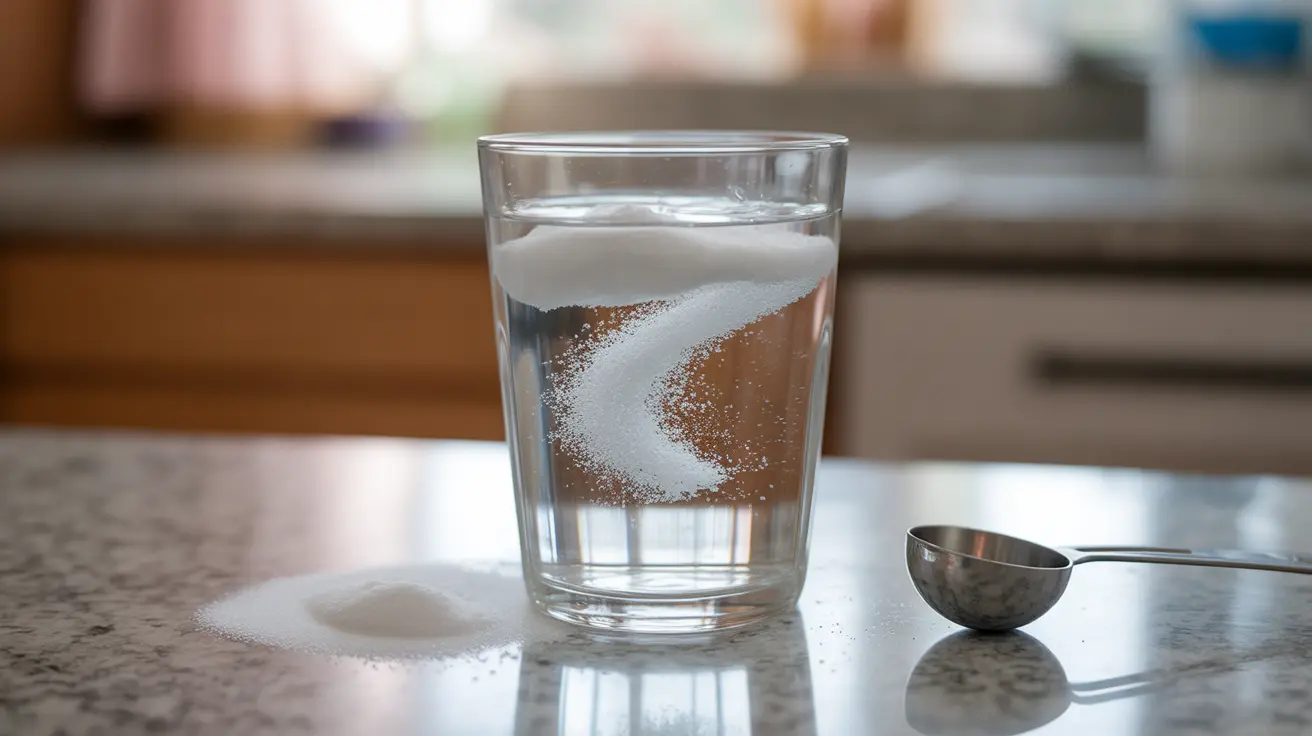
Oral sodium bicarbonate is a legitimate, FDA-recognised over-the-counter antacid (S2). The labelled dose is specific: dissolve ½ teaspoon (approximately 2,600 mg of sodium bicarbonate) in at least 4 fluid ounces (approximately 120 mL) of water. Adults aged 12 years and older may take this dose every 2 hours as needed, up to a maximum of 6 doses per day. Adults aged 60 years and older should not exceed 3 doses per day (S2).
The label also specifies that this product should not be used for more than 2 weeks, and that a doctor should be consulted if symptoms persist beyond that period (S2). Children under 12 years should not use oral sodium bicarbonate as an antacid unless directed by a physician (S2).
These are not arbitrary numbers. They represent the dosing window within which the antacid effect is achieved without crossing into the territory of clinically significant metabolic alkalosis (S1)(S2).
Why "just a teaspoon" can be too much
The single-dose amount on the FDA label is ½ teaspoon — not a full teaspoon, not a tablespoon. This distinction matters because a heaped tablespoon of baking soda contains roughly five times as much sodium bicarbonate as the recommended single dose. Many home-remedy recipes — and many internet "health tips" — casually recommend a full teaspoon or more per glass, which is already approaching or exceeding the single-dose maximum.
The body's acid-base balance is tightly regulated. Ingesting a modest amount of sodium bicarbonate is handled by the kidneys, which excrete the excess bicarbonate in urine (S1). But when the intake exceeds the kidneys' capacity to compensate — particularly if doses are repeated frequently or if the person has even mild kidney impairment — the blood pH rises above normal (alkalosis), potassium shifts into cells (hypokalemia), and sodium accumulates (hypernatremia) (S1)(S3).
When to use a proper antacid instead
Sodium bicarbonate works as an antacid, but it is not the best antacid for most people. Commercial antacid products — such as those containing calcium carbonate, magnesium hydroxide, or aluminium hydroxide — typically provide equivalent acid-neutralising capacity with a more predictable dose, fewer electrolyte side effects, and additional safety labelling that includes drug-interaction warnings (S1).
If you experience indigestion frequently enough to want an antacid more than a few times a week, the appropriate step is to see a doctor — not to increase your baking-soda intake. Persistent indigestion may indicate gastro-oesophageal reflux disease (GORD/GERD), gastritis, or another condition that benefits from diagnosis and targeted treatment rather than repeated self-dosing with sodium bicarbonate (S2).
Does baking soda improve exercise performance?
The "bicarb loading" protocol
Sodium bicarbonate has a legitimate, evidence-based application in sport — but it is specific in its dosing, timing, and target activity.
Sports-nutrition guidelines endorse a protocol in which an athlete takes approximately 0.2 to 0.4 grams of sodium bicarbonate per kilogram of body mass, dissolved in water and often consumed alongside a carbohydrate-rich meal, 60 to 150 minutes before competition (S4). For a 70 kg athlete, this translates to roughly 14–28 grams of sodium bicarbonate — a substantial amount, carefully timed, and used as a single pre-event dose.
The mechanism is buffering: during high-intensity exercise, muscles produce hydrogen ions (acid) as a byproduct of anaerobic metabolism, which contributes to the burning sensation and fatigue that limits performance. By raising the blood's bicarbonate concentration before exercise, the athlete increases the body's capacity to buffer this acid, potentially delaying fatigue (S4).
What it works for — and what it doesn't
The evidence supports modest performance improvements in high-intensity events lasting approximately 1 to 7 minutes — middle-distance running, swimming, short cycling events, and similar efforts where anaerobic metabolism is a dominant energy source (S4).
It does not work for endurance events (where the limitation is fuel, not acid buffering), for low-intensity activity, or for general "energy" in the sense that marketing materials sometimes imply (S4). It also does not work for everyone: GI upset is a common side effect of bicarb loading, and some athletes find the discomfort negates any performance benefit. This is why sports-nutrition protocols emphasise individual testing during training sessions before using the strategy in competition (S4).
Why daily baking-soda-and-salt water is not the same thing
The bicarb-loading protocol is a single, acute, pre-competition intervention — not a daily health drink. Regular daily consumption of baking-soda water at these doses would accumulate sodium, chronically alkalinise the blood, and stress the kidneys — none of which supports athletic performance and all of which increase health risk (S1)(S4).
The home-remedy claim that "drinking baking soda and salt water every day gives you more energy" conflates two unrelated things: a sport-specific buffering strategy (evidence-based, acute, dose-controlled) and a daily beverage habit (not evidence-based, chronic, dose-uncontrolled). They are not the same, and the second is not supported by the evidence that validates the first.
What are the risks of drinking baking soda and salt water?
Metabolic alkalosis — what it is and why it matters
The most clinically significant risk of excessive oral baking-soda intake is metabolic alkalosis — a condition in which the blood pH rises above the normal range of 7.35–7.45 (S1)(S3). The body's enzymes, ion channels, and signalling systems are calibrated to function within this narrow pH range. When blood becomes too alkaline, multiple systems are affected.
Metabolic alkalosis causes potassium to shift from the bloodstream into cells (hypokalemia), which can produce muscle weakness, cramping, cardiac arrhythmias, and — in severe cases — paralysis or cardiac arrest (S1)(S3). It also reduces the ionisation of calcium in the blood, which can cause tingling, muscle spasms, and neurological symptoms (S1).
Electrolyte disturbances — potassium, sodium, calcium
Beyond alkalosis itself, excessive baking-soda intake directly increases blood sodium (hypernatremia), because sodium is half of the sodium-bicarbonate molecule (S1)(S3). Adding salt to the mixture further compounds this sodium load. Hypernatremia causes thirst, confusion, and — at extreme levels — seizures and brain injury.
The potassium-lowering effect (hypokalemia) is particularly dangerous because it affects the heart's electrical conduction system. Low potassium can cause abnormal heart rhythms (dysrhythmias) that range from palpitations to life-threatening ventricular arrhythmias (S1)(S3).
GI complications
Milder GI effects — bloating, belching, gas, nausea, abdominal discomfort — are common even at recommended doses and are the reason many people prefer other antacids over baking soda (S1). At higher doses or on a full stomach, the rapid generation of carbon dioxide gas can cause significant gastric distension. In rare documented cases, this has been associated with gastric perforation (S1)(S3).
How quickly things can go wrong
The toxicity case literature documents patients who developed severe metabolic alkalosis, hypokalemia, hypernatremia, and cardiopulmonary complications after ingesting several teaspoons to tablespoons of baking soda — sometimes in a single episode, sometimes over several days of repeated high-dose use (S3). The clinical presentation included seizures, dysrhythmias, and in some cases respiratory arrest (S3).
Onset can be rapid: within hours of a large acute ingestion, or over days with repeated excessive dosing (S3). The progression from "mild discomfort" to "medical emergency" is not always gradual — it can be abrupt, particularly in people with underlying kidney impairment, heart disease, or electrolyte abnormalities (S1)(S3).
Who should not drink baking soda and salt water?
Heart failure, kidney disease, and hypertension
People with heart failure are sensitive to sodium loading — additional sodium causes fluid retention, increases blood volume, and can worsen heart-failure symptoms or precipitate acute decompensation (S1)(S5). A glass of baking-soda-and-salt water contains a substantial sodium dose that can exceed what many heart-failure patients are advised to limit in an entire day.
People with chronic kidney disease (CKD) have reduced ability to excrete excess sodium and to regulate acid-base balance. While some CKD patients are prescribed sodium bicarbonate under medical supervision to treat the metabolic acidosis that accompanies advanced kidney disease, this is a monitored intervention with regular blood-test checks — not a self-directed home remedy (S5). A meta-analysis of sodium-bicarbonate use in CKD found no significant increase in systolic blood pressure, but the study context was controlled, dose-managed supplementation — not unsupervised baking-soda-salt water (S5).
People with hypertension — even if their kidney function is normal — should be cautious about any practice that adds significant sodium to their diet, because sodium raises blood pressure in many hypertensive individuals (S1)(S5).
Children under 12
The FDA-approved antacid label for sodium bicarbonate specifies that children under 12 years should not use the product unless directed by a physician (S2). Children have smaller body mass, less mature kidney function, and less capacity to buffer acid-base disturbances, making them more vulnerable to alkalosis and electrolyte shifts from the same dose that an adult might tolerate.
Pregnancy and breastfeeding
Sodium loading and acid-base shifts during pregnancy can affect both the mother and the developing fetus. Pregnant and breastfeeding people should avoid unsupervised use of baking-soda-and-salt water and should discuss any antacid use with their midwife or obstetrician (S1)(S2).
People on specific medications
Sodium bicarbonate can interact with several medication classes. Diuretics — particularly those that already lower potassium (such as thiazides and loop diuretics) — combined with bicarbonate-induced hypokalemia can produce dangerously low potassium levels (S1). Sodium-bicarbonate also alters urine pH, which can affect the absorption and excretion of other medications, including some antibiotics, salicylates, and lithium (S1).
If you take any regular medications — particularly for blood pressure, heart failure, kidney disease, or psychiatric conditions — consult a pharmacist or doctor before using baking-soda water in any form (S1)(S2).
Is homemade baking-soda water better than commercial products?
Versus OTC antacids
Baking soda is an antacid. But "antacid" is a category, and not all antacids have the same safety profile. Commercial antacid tablets and liquids (containing calcium carbonate, magnesium hydroxide, or aluminium hydroxide) are formulated with measured doses, include drug-interaction labelling, and have undergone regulatory review for safety and efficacy (S1)(S2).
Homemade baking-soda water is imprecise by nature: a "teaspoon" varies depending on how it is measured, the baking soda may be mixed unevenly in the water, and there is no built-in safeguard against exceeding the safe dose. It is not "worse" than a commercial antacid in terms of mechanism — it does the same thing chemically — but it is less precise, less well-labelled, and easier to overdose (S1)(S2).
Versus sports drinks and electrolyte solutions
For electrolyte replacement — whether after illness, exercise, or heat exposure — commercial electrolyte solutions (including WHO-formulation oral rehydration salts and sports drinks) are substantially safer and more effective than homemade baking-soda-salt water (S4). They provide a balanced ratio of sodium, potassium, chloride, and glucose, calibrated to facilitate intestinal absorption. A glass of baking soda and salt in water provides a large, unbalanced dose of sodium and bicarbonate with no potassium and no glucose.
The claim that "you can make your own electrolyte drink at home with baking soda and salt" is technically not wrong in terms of chemistry — sodium and chloride are electrolytes — but it is misleading in terms of physiology. An effective electrolyte-replacement solution is balanced; a glass of baking soda and salt is not (S1)(S4).
Frequently asked questions
How much baking soda is safe to drink?
The FDA-labelled dose is ½ teaspoon (~2,600 mg) dissolved in 4 oz of water, up to 6 doses/day for adults ≥12, or up to 3 doses/day for adults ≥60 (S2). Do not exceed these limits. Children under 12 should not use oral baking soda as an antacid without medical direction (S2).
Can baking soda and salt water lower blood pressure?
No — and it may raise it. Both contribute sodium, which can increase blood pressure and fluid retention (S1)(S5). A meta-analysis in CKD patients found no significant BP increase from bicarbonate alone, but the added salt increases sodium load further (S5). This mixture is not a blood-pressure treatment.
Is baking soda good for athletes?
Single-dose bicarb loading (0.2–0.4 g/kg, 60–150 min before competition) can modestly improve short high-intensity performance (S4). This is a sport-specific protocol, not a daily drink. GI side effects are common and the protocol must be trialled in training first (S4).
What happens if you drink too much baking soda?
Excessive intake can cause metabolic alkalosis, low potassium, high sodium, and GI distress. In severe cases, seizures, heart-rhythm disturbances, and cardiopulmonary arrest have been documented (S1)(S3). Onset can be rapid after several teaspoons or tablespoons (S3).
Can I use baking soda water instead of antacids?
Baking soda is an antacid, but commercial products offer measured doses, safety labelling, and drug-interaction warnings that homemade mixtures lack (S1)(S2). If you need antacids for more than 2 weeks, see a doctor rather than continuing to self-treat (S2).
Sources
- [S1] StatPearls / NCBI Bookshelf. "Sodium Bicarbonate." NBK559139. 2024-02-11. https://www.ncbi.nlm.nih.gov/books/NBK559139/.
- [S2] DailyMed (FDA). "Sodium Bicarbonate Antacid — Label." 2025-07-21. https://dailymed.nlm.nih.gov/dailymed/drugInfo.cfm?setid=6efb4da0-03ae-4df6-acd7-e8023d20d4b3.
- [S3] Fitzgibbons LJ, et al. "Severe metabolic alkalosis due to baking soda ingestion." J Emerg Med, 1999;17(1):57–61. PMID: 9950389.
- [S4] Australian Institute of Sport. "Sodium Bicarbonate — Performance Supplements." 2022. Also: World Athletics sodium-bicarbonate protocol summary.
- [S5] Whiting RJ, et al. "Effect of Sodium Bicarbonate on Systolic Blood Pressure in CKD: A Meta-analysis." 2023. PMID: 36758154.