Written by: Tomasz Sadowski
This article is for educational purposes and reflects information from clinician-reviewed patient-education resources, peer-reviewed clinical references, and government health guidance. It is not a substitute for individualised medical advice. If you have concerns about changes in your stool or digestive health, consult your GP or gastroenterologist.
tl:dr
Seeing seeds or small food particles in your stool is common and usually harmless — here is what you need to know:
- Seeds, nuts, and vegetable skins contain indigestible fibre (cellulose) that the human gut is not designed to fully break down, so they often pass through intact (S1)(S2).
- This is usually normal, especially when you have recently eaten high-fibre foods, the particles are intact, and you have no other symptoms (S1).
- White specks in stool can be from food, medication casings, or — less commonly — parasites; persistent white specks with other symptoms should be evaluated (S5).
- See a doctor if undigested food is accompanied by persistent diarrhea, unexplained weight loss, blood in stool, oily or unusually pale stools, or chronic abdominal pain (S1)(S3)(S4).
- Chewing thoroughly and eating slowly may reduce visible undigested particles but will not change the fact that some fibre is inherently indigestible (S1)(S2).
Table of contents
- Why do seeds appear in stool?
- When is seeing seeds in stool normal?
- What do white specks in stool mean?
- When should you see a doctor about undigested food in stool?
- Can you do anything to reduce seeds in stool?
- Frequently asked questions
- Sources
Seeds in Stool: Normal or a Sign of a Problem?
Why do seeds appear in stool?
The role of indigestible fibre
The short answer is that your body is working exactly as designed. Seeds — along with nuts, corn kernels, and the skins of many fruits and vegetables — contain cellulose, a type of fibre that the human digestive system does not have the enzymes to break down (S1)(S2). Cellulose forms the structural wall of plant cells. It passes through the stomach and small intestine largely intact, enters the colon, and exits the body in stool. This is not a failure of digestion; it is how fibre works.
Fibre, including the indigestible cellulose in seed coats, plays an important role in digestive health. It adds bulk to stool, absorbs water to make stool softer and easier to pass, and helps regulate the speed at which material moves through the gut (S2). The fact that you can see it in the toilet does not mean your body failed to process the meal — it means the fibre did its job and came out the other end, which is exactly what is supposed to happen.
Which seeds commonly pass through undigested?
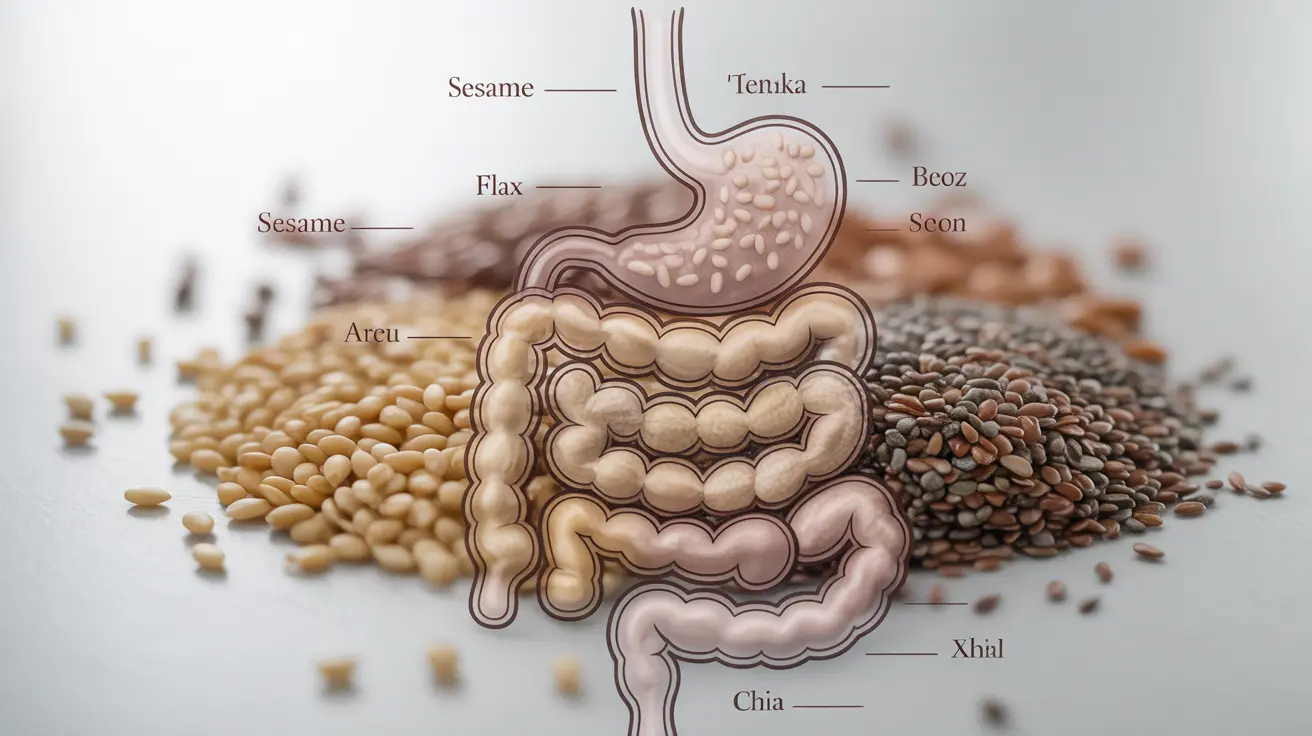
Many seeds have particularly tough outer shells that are especially resistant to digestion. Sesame seeds, flax seeds, chia seeds, sunflower seed fragments, and the tiny seeds embedded in strawberries, kiwi fruit, and tomatoes are all commonly noticed in stool (S1)(S2). Whole corn kernels are another frequent example — the interior starch is digested, but the yellow cellulose casing passes through and is visible.
The size and hardness of the seed affects how noticeable it is. Tiny strawberry seeds may pass unnoticed. Larger whole flax seeds or chia seeds, especially if swallowed without chewing, are more conspicuous. This is a matter of physics and plant anatomy, not a digestive deficiency.
Does this mean something is wrong with your digestion?
In the vast majority of cases, no. Seeing recognisable seeds, skins, or vegetable fragments in stool — particularly after a meal containing those foods — is normal and expected (S1). The digestive system is not designed to completely disintegrate every component of every food. Indigestible fibre is, by definition, the material that passes through.
The question shifts from "normal" to "worth investigating" only when undigested food in stool is accompanied by other symptoms — persistent diarrhea, weight loss, oily or unusually pale stools, blood, or chronic abdominal pain (S1)(S3). Without those symptoms, visible seeds in stool are a dietary observation, not a medical finding.
When is seeing seeds in stool normal?
The "usually normal" checklist
Visible seeds or food particles in stool are considered normal when all of the following apply (S1)(S2):
You have recently eaten foods containing seeds, nuts, or high-fibre material. The particles look like intact, recognisable food fragments — not like something unfamiliar or unrelated to your diet. You have no other symptoms — no diarrhea, no pain, no blood, no weight change. It happens occasionally, not with every bowel movement regardless of diet.
If all four of these conditions are met, there is generally no reason for concern and no need for medical evaluation (S1).
What changes the picture from normal to concerning
The same observation — visible particles in stool — takes on different significance when it occurs alongside other symptoms. The transition from "normal" to "potentially concerning" is not about the seeds themselves but about the company they keep (S1)(S3)(S4).
If undigested food is accompanied by persistent diarrhea (lasting more than a few days without a clear dietary cause), this may suggest that material is moving through the gut too quickly for adequate digestion and absorption (S2)(S3). If it is accompanied by unexplained weight loss, this raises the possibility of malabsorption — a condition in which the gut is not effectively absorbing nutrients despite adequate intake (S3)(S4). Oily, pale, or unusually bulky stools (steatorrhea) are a more specific sign of fat malabsorption and should be evaluated (S3)(S4). Blood in the stool — whether bright red or dark and tarry — is always a reason to see a doctor, regardless of whether seeds are also present (S1)(S3).
The visible seeds in these scenarios are not the problem. They are a visible reminder that the gut is not functioning optimally, and the underlying cause — whether it is coeliac disease, inflammatory bowel disease, pancreatic insufficiency, or another condition — is what needs to be identified and treated (S3)(S4).
What do white specks in stool mean?
Food and medication remnants
White specks in stool are a separate question from visible seeds, though people often conflate them. The most common causes are benign: undigested fragments of certain foods (such as seeds, nuts, or grains that have a pale interior), and the casings of controlled-release medications or supplements, which are designed to pass through the gut intact after releasing their active ingredient (S2)(S5).
Controlled-release pill casings, sometimes called "ghost tablets," can appear as small, pale, intact-looking objects in stool. This is by design — the medication was absorbed, and the empty shell was excreted. If you are taking any controlled-release medications and notice white specks, this is the likely explanation.
Parasites — when to consider them
White specks in stool can, less commonly, represent segments of intestinal parasites — for example, proglottids (body segments) of tapeworms or, in children, pinworms (S5). This possibility should be considered when white specks are persistent (appearing repeatedly over days or weeks), are not clearly related to food or medication, and are accompanied by other symptoms such as abdominal pain, weight loss, itching around the anus (particularly at night, in the case of pinworms), or changes in appetite (S5).
It is important not to jump to this conclusion. White specks in stool are much more commonly from food or medication than from parasites. The appropriate response to persistent, unexplained white specks is to see a doctor for evaluation — not to self-diagnose a parasitic infection based on appearance alone.
How parasites are tested for
If a clinician suspects an intestinal parasite, the standard diagnostic approach is stool examination for ova (eggs) and parasites (S5). This typically requires three separate stool samples collected on different days, because parasite shedding can be intermittent — a single negative sample does not rule out infection (S5). Special stains or concentration techniques may be used for difficult-to-detect organisms (S5).
The process is straightforward: you collect small stool samples at home using a kit provided by the clinic or laboratory, return them for analysis, and results are typically available within a few days. If parasites are identified, treatment is usually with specific antiparasitic medications prescribed by your doctor.
When should you see a doctor about undigested food in stool?
Red-flag symptoms
Visible seeds or food particles in stool do not, on their own, require medical evaluation. However, they should prompt a medical appointment when they are accompanied by any of the following (S1)(S3)(S4):
Persistent diarrhea — lasting more than a few days without an obvious dietary or infectious explanation. Unexplained weight loss — losing weight without intentionally dieting or increasing physical activity. Blood in the stool — whether bright red, dark, or tarry. Oily, pale, or unusually bulky stools — suggesting fat malabsorption. Chronic abdominal pain or severe bloating. Fatigue or signs of nutritional deficiency (such as brittle nails, hair loss, or mouth sores) alongside visible undigested food.
Any of these in combination with frequently visible undigested food raises the possibility of a malabsorption syndrome or another gastrointestinal condition that needs diagnosis and treatment (S3)(S4).
What malabsorption looks like
Malabsorption is a clinical term for the impaired absorption of nutrients from the gut. It should be suspected when chronic diarrhea, weight loss, and signs of specific nutrient deficiencies occur together (S3)(S4). The stool in malabsorption may be bulky, pale, oily (floating and difficult to flush), and foul-smelling — a pattern distinct from simply seeing a few intact seeds (S3)(S4).
Malabsorption has many possible causes, including coeliac disease, Crohn's disease, chronic pancreatitis, small-intestinal bacterial overgrowth, and others. Identifying the cause requires clinical evaluation, blood tests (for nutrient levels, coeliac markers, and inflammatory markers), and stool tests (for fat content, blood, and pathogens) (S3)(S4). This is not a self-diagnosable condition, and visible seeds in stool are not, by themselves, a diagnostic criterion for it (S3)(S4).
What to expect at the appointment
If you see a doctor about persistent undigested food with accompanying symptoms, the evaluation will typically include a detailed history (what you eat, how long the symptoms have lasted, whether there is weight loss or blood), a physical examination, and targeted tests. Blood work may check for anaemia, nutrient deficiencies, coeliac antibodies, and inflammatory markers. Stool tests may check for fat content, blood, and ova and parasites (S3)(S5). In some cases, imaging or endoscopy may be recommended depending on the clinical picture (S4).
The goal is not to investigate the seeds — they are normal. The goal is to determine whether the accompanying symptoms reflect an underlying condition that needs treatment.
Can you do anything to reduce seeds in stool?
Chewing, soaking, and grinding
Several practical strategies can reduce the amount of visibly undigested material in stool (S1)(S2):
Chew food thoroughly and eat slowly. Poor chewing and fast eating are explicitly noted as factors that increase visible undigested food in stool (S1). This is the simplest and most effective change.
Grind seeds before eating them. Flax seeds and chia seeds, in particular, are often more nutritionally accessible when ground, because the grinding breaks the tough outer shell and exposes the interior nutrients to digestive enzymes (S2). Whole flax seeds, in particular, can pass through the gut entirely intact.
Soak seeds before consuming them. Soaking softens the outer coating and may make seeds easier to chew and partially digest (S2).
Start with smaller portions if you are new to high-fibre foods. A sudden increase in fibre intake can cause bloating, gas, and more visible undigested material. Gradual introduction allows the gut to adjust (S2).
Stay well hydrated. Fibre absorbs water, and adequate hydration helps it move through the gut smoothly and do its job effectively (S2).
What these tips can and cannot do
These strategies may reduce the visible undigested material you see in stool, and grinding or soaking seeds may increase the proportion of nutrients your body absorbs from them (S2). However, they do not — and cannot — eliminate indigestible fibre from your diet, nor should they. Fibre is an essential component of a healthy diet, and its partial indigestibility is the mechanism by which it supports regular bowel movements, colon health, and metabolic function (S2).
The goal is not to make stool perfectly uniform and particle-free. The goal is to eat a varied, high-fibre diet, prepare foods in a way that maximises nutrient availability, and recognise that some visible remnants are a normal, healthy byproduct of that diet. If the visible material is accompanied by concerning symptoms, evaluate the symptoms — not the seeds.
Frequently asked questions
Is it normal to see seeds in your poop?
Yes, in most cases. Seeds contain indigestible fibre (cellulose) that the human gut cannot fully break down, so they often pass through intact (S1)(S2). This is normal after eating high-fibre foods and does not indicate a digestive problem unless accompanied by symptoms such as persistent diarrhea or weight loss (S1).
Why do chia seeds and flax seeds appear whole in stool?
Chia and flax seeds have tough outer shells made of cellulose that resist digestive enzymes (S1)(S2). Grinding them before eating releases more of the nutrients inside, but some indigestible material will still pass through — this is how fibre works.
Are white specks in stool parasites?
They can be, but most white specks are from food or medication casings (S5). Diagnosis of parasites requires stool testing — typically three samples collected on different days (S5). If specks persist or come with abdominal pain or weight loss, see a doctor.
When should I worry about undigested food in my stool?
See a doctor if undigested food is accompanied by persistent diarrhea, unexplained weight loss, blood in the stool, oily or pale stools, or chronic abdominal pain (S1)(S3)(S4). These may indicate malabsorption or another GI condition that needs evaluation.
Does grinding seeds help with digestion?
Grinding breaks the outer shell and makes nutrients more accessible (S2). However, the fibre component remains inherently indigestible — grinding reduces visible particles but does not eliminate them entirely, and it does not guarantee improved nutrient absorption (S1)(S2).
Sources
- [S1] Mayo Clinic. "Undigested food in stool: What does it mean?" Expert Answers. 2023-10-12. https://www.mayoclinic.org/diseases-conditions/diarrhea/expert-answers/undigested-food-in-stool/faq-20058093.
- [S2] WebMD. "What to Know About Undigested Food in Your Stool." 2023-09-10. https://www.webmd.com/digestive-disorders/what-to-know-about-undigested-food-in-stool.
- [S3] StatPearls / NCBI Bookshelf. "Malabsorption Syndromes." NBK553106. 2025-07-06. https://www.ncbi.nlm.nih.gov/books/NBK553106/.
- [S4] Lenti M, et al. "European Consensus on Malabsorption." United European Gastroenterology Journal, 2025. https://pmc.ncbi.nlm.nih.gov/articles/PMC12090837/.
- [S5] CDC. "Diagnosis of Parasitic Diseases." 2024-12-16. https://www.cdc.gov/parasites/testing-diagnosis/index.html.